

Satyanarayan Vrat Katha
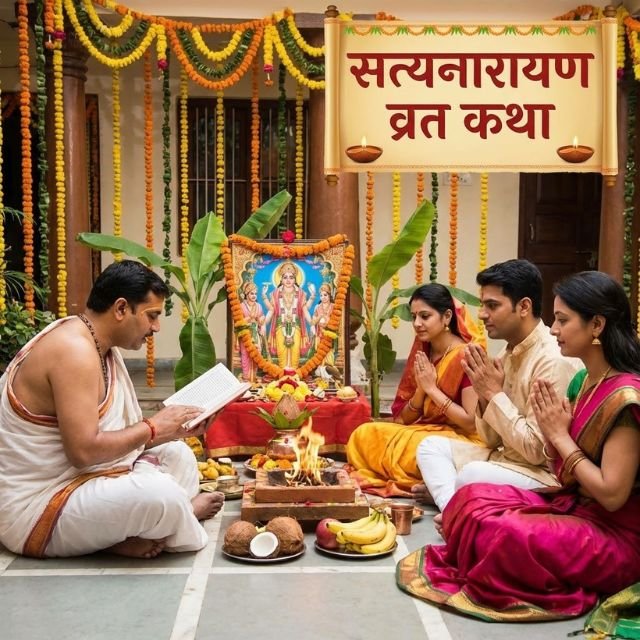
Puja Service Information
The path to overcoming obstacles lies in the worship of Truth.
Category :
Vedic Ritual & Thanksgiving
Ideal Time :
Purnima (Full Moon), Ekadashi, Sankranti, or Thursdays
Duration :
2 – 3 Hours (Approx.)
Locations :
Delhi, Ghaziabad, Gurugram & NCR
Service By :
Verified Vedic Pandits & Acharyas
Rating :
Satyanarayan Vrat Katha: 5 Sacred Steps for Invoking Divine Truth & Prosperity
In the bustling life of modern cities, finding moments of pure spiritual connection can be difficult. However, Vedic tradition offers us a simple yet profoundly powerful ritual to bridge the gap between the mundane and the divine: the Satyanarayan Vrat Katha.
Revered as one of the most popular and effective rituals in Hindu Sanatan Dharma, this puja is dedicated to Lord Satyanarayan, a benevolent form of Lord Vishnu who embodies “Truth” (Satya). Whether you have just bought a new home in Gurugram, are celebrating a career milestone in Delhi, or simply wish to restore peace in your household in Ghaziabad, performing this sacred Katha brings immediate spiritual relief and positivity.
We specialize in conducting this ritual with absolute purity, adhering to the traditional narratives found in the Skanda Purana, ensuring that your family receives the full fruit of the worship.
What is the Satyanarayan Vrat Katha?
The term Satyanarayan Vrat Katha is derived from two words: Satya (Truth) and Narayana (The Supreme Being/Vishnu). Therefore, this ritual is the worship of the “Supreme Truth.” It is unique because it combines a Vrat (fasting/vow) with a Katha (narrative story).
Unlike complex Yajnas that require elaborate setups, the Satyanarayan Vrat Katha is accessible to everyone. It is a ritual of thanksgiving. Traditionally, it is performed to express gratitude to the Almighty for the fulfillment of desires—be it the birth of a child, a marriage, a new job, or simply the well-being of the family.
When you book our services, our learned Pandits do not just recite Sanskrit verses; they explain the profound meaning behind the Satyanarayan Vrat Katha, transforming a simple ritual into a spiritual awakening for all attendees.
The Significance of Performing This Vrat
Why has this specific puja stood the test of time? The answer lies in its simplicity and potency.
Removal of Obstacles: Lord Satyanarayan is the preserver of the universe. Invoking him removes hurdles in professional and personal life.
Harmony in Home: The vibrations created during the Satyanarayan Vrat Katha cleanse the domestic environment, reducing family conflicts.
Fulfillment of Wishes: It is widely believed that a devotee who listens to this Katha with a focused mind (Chitta) sees their honest desires manifest.
Mental Peace: In the stress of city life in Delhi or Ghaziabad, the rhythmic chanting acts as a mental detox, restoring clarity and calm.
When Should You Perform It?
While the Satyanarayan Vrat Katha can be performed on any day, certain timing amplifies its effects:
Purnima (Full Moon): This is considered the most auspicious day as the moon’s energy is at its peak, conducive to spiritual practices.
Sankranti: The transition of the Sun into a new zodiac sign.
Thursdays: Dedicated to Lord Vishnu and Brihaspati (Jupiter).
Special Occasions: Griha Pravesh (House Warming), Annaprashan, or before a wedding.
The Divine Narrative: Understanding the 5 Chapters
The core of the ritual is the recitation of the Satyanarayan Vrat Katha, which is divided into five chapters (Adhyayas). Each chapter conveys a specific moral lesson about faith, truth, and the consequences of disregarding the divine. Our Pandits recite these stories with engagement and devotion.
Chapter 1: The Origin
The first chapter sets the stage. It is a dialogue between Suta Puranik and the Rishis at Naimisharanya. Suta ji narrates how Narada Muni, seeing the suffering of Earth’s beings, approached Lord Vishnu. Vishnu revealed the Satyanarayan Vrat Katha as the ultimate remedy for suffering in the Kali Yuga. This chapter establishes the authority of the ritual.
Chapter 2: The Poor Brahmin
This story involves a poor Brahmin in Kashi who was suffering from extreme poverty. Lord Vishnu appeared in the guise of an old Brahmin and advised him to perform the Satyanarayan Vrat Katha. Upon doing so, the Brahmin was blessed with wealth and prosperity. A woodcutter, witnessing the Brahmin’s puja, also decided to perform it. He, too, became wealthy and happy. Lesson: Faith transcends social status. God listens to the poor and the rich alike.
Chapter 3: The Merchant Sadhul
This chapter tells the tale of a merchant named Sadhul. He vowed to perform the puja but kept postponing it—first until his daughter’s marriage, then later. Due to this procrastination and breaking of his vow, he faced immense misery, imprisonment, and loss of wealth. Only when his wife performed the Satyanarayan Vrat Katha back home did his fortunes reverse. Lesson: Do not procrastinate on spiritual vows. Gratitude should not be delayed.
Chapter 4: The Importance of Prasad
This continues the merchant’s story. On his return voyage, he lied to a Dandi Sanyasi (Lord in disguise) about the contents of his boat. His wealth vanished until he confessed the truth. Later, his daughter, in her excitement to see her husband, forgot to consume the holy Prasad of the Satyanarayan Vrat Katha. Her husband’s boat sank as a result. Only after she respected the Prasad did the tragedy avert. Lesson: Respect for the divine offering (Prasad) and truthfulness is paramount.
Chapter 5: King Tungadhwaja
The final chapter describes King Tungadhwaja, who arrogantly ignored a group of cowherds performing the puja. He refused the Prasad, considering it beneath his dignity. Consequently, he lost his kingdom and sons. Realizing his ego was the cause, he returned to the cowherds, partook in the Satyanarayan Vrat Katha with humility, and regained everything. Lesson: Ego is the biggest barrier to grace.
Detailed Vidhi: How We Conduct the Puja
A proper Satyanarayan Vrat Katha is a systematic process. We ensure no step is skipped.
1. Ganapati & Gauri Puja Every Vedic ritual begins with Lord Ganesha to remove obstacles. We also worship Goddess Gauri and the Navagrahas (Nine Planets) to balance planetary energies.
2. Kalash Sthapana A copper or silver pot (Kalash) is filled with water, betel nuts, coins, and mango leaves, topped with a coconut. This represents the universe and the body of the deity. Varuna (God of Water) is invoked here.
3. Vishnu Aavahan & Aasan An image or idol of Lord Satyanarayan is placed on a yellow cloth. Flowers and Akshat (rice) are offered as we invite the Lord to take his seat (Aasan).
4. Panchanavahan We invoke the five deities: Ganesha, Suryanarayan, Vishnu, Shiva, and Durga.
5. The Katha Recitation This is the heart of the ceremony. The Pandit ji recites the 5 chapters detailed above. It is mandatory for the Yajman (host) and family to listen attentively.
6. Havan (Optional) While not always mandatory for a basic Katha, performing a small Havan with Vishnu Sahasranama aids in purifying the house atmosphere.
7. Aarti & Pushpanjali The puja concludes with the singing of “Jai Jagdish Hare” and the offering of flowers.
The Sacred Prasad: Sapaad Bhaksh
A unique aspect of the Satyanarayan Vrat Katha is the specific Prasad known as Sapaad Bhaksh (often called Shinni or Panjiri/Sheera).
It is prepared using equal parts (1.25 measures) of:
Wheat Flour (Atta) or Semolina (Sooji)
Ghee (Clarified Butter)
Sugar
Milk
Bananas
The measurement of “1.25” symbolizes that our devotion should always be a little more than our capacity. We guide you on how to prepare this Prasad hygienically and accurately to ensure it is worthy of offering.
Astrological Benefits
Beyond the spiritual, there are astrological reasons to perform the Satyanarayan Vrat Katha.
Strengthening Jupiter (Guru): Lord Vishnu is the deity of Jupiter. If you have a weak Guru in your horoscope, this puja helps in gaining wisdom, education, and wealth.
Reducing Doshas: It is effective in pacifying Pitra Dosh and Vishnu Shap.
Planetary Peace: The Navagraha puja performed before the Katha balances the malefic effects of Saturn and Rahu.
For more information on planetary alignments, you might find this resource on Hindu Astrology helpful.
Why Choose Us in Delhi, Ghaziabad, and Gurugram?
Finding a Pandit who recites the Katha with clear pronunciation and explains the meaning is rare. Here is why we are the preferred choice in the NCR region:
1. Authentic Vedic Procedure We follow the strict Vidhi prescribed in the Skanda Purana. We do not rush through the verses. We ensure the Satyanarayan Vrat Katha is a meditative experience for you.
2. Complete Samagri Management We provide a detailed list of items well in advance. For those with busy schedules in Gurugram or Delhi, we can bring the complete Puja Samagri kit (flowers, fruits, sweets excluded) for a hassle-free experience.
3. Multilingual Pandits Our Acharyas can explain the essence of the Katha in Hindi, English, and regional languages, ensuring the younger generation understands the values being taught.
4. Punctuality & Professionalism We value your time. If the Muhurat is for 6:00 PM, we begin the setup by 5:30 PM.
Our Packages
We offer flexible options to suit your needs:
Standard Package: Includes Ganesha Puja, Kalash Sthapana, Satyanarayan Vrat Katha, and Aarti. (Ideal for monthly Purnima).
Premium Package: Includes all of the above plus a Navagraha Shanti Puja and a Havan. (Ideal for Griha Pravesh or special occasions).
Grand Package: Includes elaborate decoration, Bhajan Mandali, and Brahmin Bhoj.
You can also combine this puja with our Griha Pravesh Puja services for a complete house-warming solution.
Frequently Asked Questions (FAQs)
Q1: Can we perform Satyanarayan Vrat Katha in the evening? Yes, traditionally, this puja is performed in the evening (“Pradosh Kaal”) to allow friends and family to gather after work. However, morning Muhurats are also auspicious.
Q2: Is fasting mandatory? While it is called a “Vrat” (fast), strict fasting is not compulsory for everyone. You can observe a partial fast (eating fruits/milk) until the puja is over and the Prasad is consumed.
Q3: Can a single person perform this puja? Yes. While it is often done by couples, a single individual can definitely perform the Satyanarayan Vrat Katha for their own well-being and spiritual growth.
Q4: What is the cost of the puja in Delhi NCR? The Dakshina varies based on the package and location (e.g., traveling to distant parts of Ghaziabad or Noida). Please contact us for a transparent quote.
Q5: How often should we do this? Many families make a vow to perform it once a year. However, doing it on every Purnima (Full Moon) brings immense stability to the household.
Client Testimonials
“I was looking for a Pandit ji for Satyanarayan Vrat Katha in Indirapuram, Ghaziabad. The Acharya who came was very knowledgeable. He explained the story so well that even my children listened intently. Highly recommended.” – Vikram Singh, Indirapuram
“We moved to a new flat in Gurugram and wanted to start with a puja. The team arranged everything perfectly. The vibrations during the Katha were amazing.” – Sneha & Amit, Sector 48, Gurugram
“Professional service in Delhi. They arrived on time, the Samagri was authentic, and the puja was conducted with great devotion.” – Mrs. Kapoor, Lajpat Nagar
Final Thoughts: Embrace the Truth
The Satyanarayan Vrat Katha is more than a ritual; it is a reminder that Truth alone triumphs (Satyameva Jayate). It is a call to align our lives with honesty and gratitude.
In the chaos of our daily lives, giving 2-3 hours to this divine story can recharge your spiritual batteries and bring unparalleled peace to your home.
Ready to Invite Prosperity?
Don’t wait for a crisis to turn to the Divine.
Bring blessings into your home today. Contact Us Now to book your Satyanarayan Vrat Katha in Delhi, Ghaziabad, or Gurugram. Let our expert Pandits guide you toward a future filled with light and abundance.