Pitru Dosh Nivaran Puja
Puja Service Information
Honoring the past to secure a blessed future.
Category :
Vedic Ritual & Ancestral Healing
Ideal Time :
Tuesdays, Chaturthi, or Specific Muhurats
Duration :
3 – 5 Hours (Depending on Vidhi)
Locations :
Delhi, Ghaziabad, Gurugram & NCR
Service By :
Verified Vedic Pandits & Acharyas
Rating :
Pitru Dosh Nivaran Puja: 7 Sacred Steps for Healing Ancestral Karma
In the journey of life, we often encounter invisible walls. Despite our best efforts, hard work, and intelligence, success remains elusive. We might face unexplained health issues, constant family discord, or persistent delays in marriage and progeny. According to Vedic Astrology, these are not mere coincidences; they are often the manifestations of “Pitru Dosh”—the karmic debt of our ancestors.
The Pitru Dosh Nivaran Puja is the most profound spiritual intervention available in Sanatan Dharma to address these deep-rooted issues. It is not just a ritual; it is an act of compassion and gratitude towards those who came before us. By satisfying the unfulfilled desires of our ancestors and releasing them from their karmic bondage, we pave the way for our own prosperity and peace.
We specialize in conducting this sensitive and powerful ritual with absolute adherence to Vedic scriptures in Delhi, Ghaziabad, Gurugram, and the wider NCR region. Our goal is to transform this “Dosh” (defect) into a “Yoga” (blessing).
Understanding Pitru Dosh: The Ancestral Debt
To understand the Pitru Dosh Nivaran Puja, one must first understand the concept of Pitru Dosh. In Vedic astrology, the Sun represents the father and the soul. When the Sun is afflicted by malefic planets like Rahu or Ketu in a horoscope—especially in the 9th house (House of Father/Luck)—it creates Pitru Dosh.
However, this is not merely a planetary alignment. It signifies that our ancestors (Pitrus) are in a state of unrest. They may be stuck in a limbo state (Preta Yoni) due to unfinished business, lack of proper funeral rites, or bad karma accumulated during their lifetime. Because we share their DNA and spiritual lineage, their unrest manifests as turmoil in our lives.
The Pitru Dosh Nivaran Puja acts as a bridge. Through specific mantras and offerings (Pind Daan), we provide the spiritual energy our ancestors need to ascend to the Pitru Loka (Ancestral Realm), thereby freeing us from their negative influence.
Signs You Need a Pitru Dosh Nivaran Puja
How do you differentiate between bad luck and Pitru Dosh? Astrologers identify specific symptoms that persist across generations. If your family is experiencing the following, this puja is highly recommended:
-
Progeny Issues: Difficulty in conceiving, frequent miscarriages, or the birth of physically challenged children is a classic sign.
-
Chronic Disease: An illness that runs in the family and defies medical diagnosis or treatment.
-
Marriage Obstacles: Constant delays in marriage or a turbulent married life filled with misunderstandings.
-
Financial Instability: Despite earning well, money never stays. Debts pile up, and sudden losses occur frequently.
-
Dream Visitations: Frequently dreaming of snakes or seeing ancestors asking for food/clothing in dreams.
-
Family Discord: Constant fighting between father and son or siblings without a valid reason.
Performing the Pitru Dosh Nivaran Puja helps to neutralize these symptoms effectively.
The Importance of Performing This Ritual
Many people ask, “Why should I pay for the sins of my ancestors?” The Vedic view is one of interconnectedness. Just as we inherit our ancestors’ assets and physical features, we also inherit their karmic debts.
Ignoring this duty can lead to the Dosh continuing into the next generation. Conversely, performing the Pitru Dosh Nivaran Puja turns the ancestors into powerful guardian angels. Once satisfied, the Pitrus bless their lineage with immense wealth, wisdom, and lineage continuity (Vansha Vridhi).
In cities like Delhi and Gurugram, where traditional family structures are fragmenting, this ritual reconnects us to our roots, restoring a sense of belonging and spiritual safety.
Detailed Vidhi: The 7 Sacred Steps
The Pitru Dosh Nivaran Puja is a complex ritual that requires precision. A simple Havan is not enough; it involves specific rites of passage for the departed souls. Here is how our expert Pandits conduct the ceremony:
1. Sankalp and Prayashchit (Vow and Atonement)
The process begins with the Sankalp. The Yajman (host) declares their name, Gotra, and intent to liberate specific ancestors (known and unknown). This is followed by Prayashchit, asking for forgiveness for any known or unknown mistakes made towards the ancestors.
2. Maha Vishnu and Aryama Puja
Lord Vishnu is the Moksha-Karaka (Grantor of Liberation). We worship him along with Aryama, the chief deity of the Pitrus. Invoking them ensures that the offerings reach the intended souls.
3. Tripindi Shradh
This is a crucial part of the Pitru Dosh Nivaran Puja. We offer three Pinds (balls of rice/barley) to satisfy three categories of ancestors:
-
Those who died in childhood or youth.
-
Those who died in old age.
-
Those who died unnatural deaths. This ensures no soul is left out.
4. Tarpan (Water Libation)
Water mixed with black sesame seeds (Til), Kusha grass, and milk is offered. The black sesame seeds are believed to absorb negativity and satisfy the thirst of the souls. This is done facing south, the direction of the Pitrus.
5. Pind Daan (Food Offering)
Balls made of cooked rice, ghee, honey, and black sesame are offered. This represents physical nourishment for the spirit body. This step is essential for the Pitru Dosh Nivaran Puja to be effective.
6. Pitru Sukta Havan
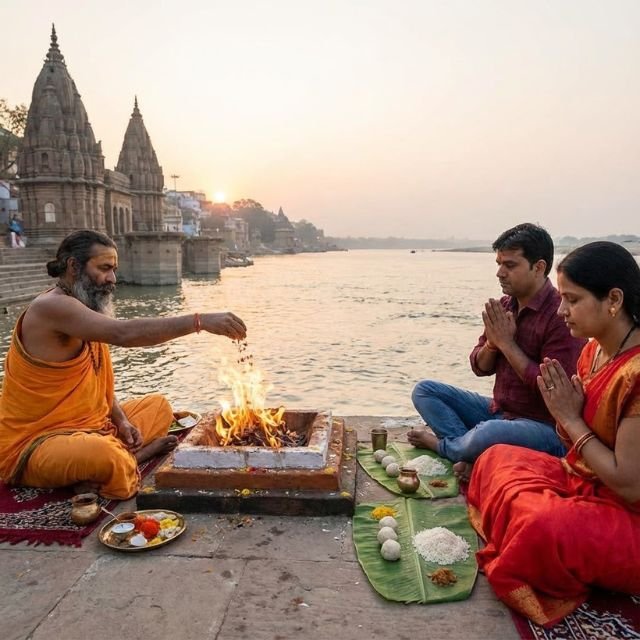
We perform a fire ritual chanting the Pitru Suktam from the Rig Veda. The fire (Agni) acts as the messenger, carrying the essence of the mantras and offerings directly to the other realms.
7. Brahman Bhoj and Daan
The ritual is incomplete without feeding Brahmins. It is believed that food eaten by a pure Brahmin during this puja reaches the ancestors directly. We also facilitate Daan (charity) of items like clothes, grains, and vessels.
The Science Behind the Ritual
Skeptics often question the logic of offering food to the dead. However, the Pitru Dosh Nivaran Puja is based on the science of vibration and subtle energy.
Everything in the universe is energy. Sound (Mantras) and matter (Pind/Rice) can be converted into energy frequencies. The specific mantras chanted during the puja create a vibration that resonates with the frequency of the spirit world. The “food” offered is not consumed physically by the ancestors but is consumed in its “essence” or subtle form (Tanmatra).
Furthermore, the ritual has a psychological benefit for the living. It provides closure, reduces anxiety about the past, and fosters a mindset of gratitude, which is essential for mental well-being.
Why Choose Us in Delhi NCR?
The Pitru Dosh Nivaran Puja is sensitive. If done incorrectly, it can sometimes disturb the ancestors further. Therefore, the qualification of the Pandit is paramount.
1. Verified Lineage: Our Pandits hail from traditional priestly families of Kashi (Varanasi), Haridwar, and Gaya. They have the authority and knowledge to perform Shradh rites.
2. Appropriate Locations: In Delhi NCR, we can organize this puja at specific riverside locations (like the Yamuna ghats) or at designated temples in Ghaziabad and Gurugram that allow Shradh rituals. We ensure the place is pure and suitable.
3. Complete Samagri Handling: The ingredients for this puja (Kusha grass, specific flowers, Black Til) must be pure. We source everything ourselves to ensure no compromise on quality.
4. Post-Puja Guidance: We don’t just finish the puja and leave. We advise you on what to do for the next 11 days, what to donate, and how to maintain the positivity generated.
Ideal Timing for the Puja
While the puja can be done on any Amavasya (New Moon), certain times are considered highly auspicious for Pitru Dosh Nivaran Puja:
-
Pitru Paksha: The 16-day lunar period in September/October dedicated solely to ancestors.
-
Somvati Amavasya: A new moon falling on a Monday.
-
Bhaumvati Amavasya: A new moon falling on a Tuesday.
-
Grahan (Eclipse): Solar or Lunar eclipses are powerful times for clearing karmic debts.
Our Customized Packages
We understand that every family’s situation and budget are different. We offer three tiers of service:
1. Ekodrishti Shradh Package
-
Focus: For a specific known ancestor (e.g., father or grandfather).
-
Includes: Tarpan, single Pind Daan, and basic Havan.
-
Duration: 2 Hours.
-
Pandits: 1.
2. Tripindi Shradh Package (Recommended)
-
Focus: For unknown ancestors and removal of general Pitru Dosh.
-
Includes: Tripindi Vidhi, Vishnu Puja, detailed Tarpan, and Havan.
-
Duration: 3-4 Hours.
-
Pandits: 2-3.
3. Narayan Bali Package (Premium)
-
Focus: For severe Pitru Dosh caused by unnatural deaths (suicide, accidents).
-
Includes: Narayan Bali Vidhi (mock funeral), extensive Havan, Gau Daan (cow donation symbol), and Brahmin Bhoj.
-
Duration: 5-6 Hours.
-
Pandits: 5.
Distinction Between General Shradh and Nivaran Puja
It is important not to confuse the annual Shradh with Pitru Dosh Nivaran Puja.
-
Annual Shradh: A yearly duty performed on the death anniversary to maintain the ancestors’ satisfaction.
-
Nivaran Puja: A specific remedial ritual performed once (or periodically) to cure a defect (Dosh) and liberate souls that are stuck. It is much more intense and elaborate.
Astrological Connection: The Sun and Rahu
In your birth chart, the Sun represents authority, vitality, and the father. Rahu represents illusion, smoke, and past karma. When these two sit together or aspect each other, the Sun’s light is “eclipsed.”
This eclipse in your chart mirrors the “eclipse” of your ancestors’ blessings. The Pitru Dosh Nivaran Puja essentially clears this smoke. It separates the energy of Rahu from the Sun, allowing the Sun (your luck and vitality) to shine brightly again.
For further reading on the astrological implications of the Lunar Nodes (Rahu/Ketu), you can explore this resource on Rahu and Ketu in Hindu Astrology.
Frequently Asked Questions (FAQs)
Q1: Can women perform Pitru Dosh Nivaran Puja? Traditionally, the eldest son performs the rites. However, in the absence of a son, a daughter can and should perform the puja. Vedic scriptures allow women to perform Tarpan and Pind Daan for their parents.
Q2: Can we do this puja at home? Basic Tarpan can be done at home. However, the full Pitru Dosh Nivaran Puja (especially Tripindi or Narayan Bali) is best performed at a temple, a riverbank, or a specific Tirth Sthan (pilgrimage site) to ensure the energies are handled correctly. We can arrange suitable venues in Delhi NCR.
Q3: How soon can we see results? Many clients report a feeling of lightness and peace immediately after the puja. Tangible results like marriage finalization or health improvement often manifest within 40 to 90 days, provided the ritual was done with faith.
Q4: Is it necessary to go to Gaya or Haridwar? While Gaya is the supreme seat for Shradh, traveling there is not always feasible. The scriptures state that a puja performed with true devotion and correct Vidhi by a learned Pandit in your local area (like Ghaziabad or Gurugram) is equally effective.
Q5: What should we eat on the day of the puja? The family should observe a strict Satvik diet (no onion, garlic, non-veg, alcohol) on the day of the puja and ideally for the entire day prior.
Final Thoughts: Liberation is a Gift
The Pitru Dosh Nivaran Puja is not just about solving problems; it is about love. It is about telling your ancestors, “I remember you, I honor you, and I set you free.”
When you heal your roots, the tree of your life naturally bears sweet fruit. Do not let ancestral burdens hold you back any longer.
Ready to Heal Your Lineage?
Break the cycle of bad luck and invite ancestral blessings.
Take the first step towards a brighter future today. Contact Us Now to consult with our Senior Acharya and book your Pitru Dosh Nivaran Puja in Delhi, Ghaziabad, or Gurugram. We are here to guide you from darkness to light.