

Gandmool Shanti Puja
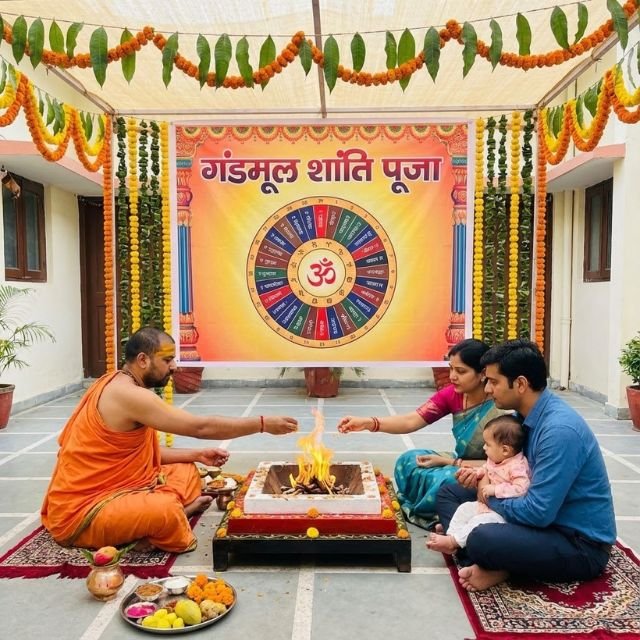
Puja Service Information
Restoring balance and ensuring a bright future through Vedic wisdom.
Category :
Vedic Ritual & Dosha Nivaran
Ideal Time :
27th Day from Birth (Nakshatra Return)
Duration :
4 - 6 Hours (Approx.)
Locations :
Delhi, Ghaziabad, Gurugram & NCR
Service By :
Expert Vedic Pandits & Acharyas
Rating :
Gandmool Shanti Puja: Pacifying the Nakshatras for a Bright Future
The birth of a child is a momentous occasion, bringing immense joy and new responsibilities to a family. However, in Vedic astrology, the specific time and constellation (Nakshatra) of birth play a pivotal role in shaping the newborn’s destiny. If your child was born under specific planetary conditions known as Gandmool, you might be worried about the implications. There is no need for panic. The ancient Vedic remedy of Gandmool Shanti Puja is a powerful, time-tested ritual designed to neutralize these effects and pave the way for a healthy, prosperous life.
Performing a Gandmool Shanti Puja is not just a ritual; it is a protective shield for the child and the parents against the malefic influences of the “Gandanta” period. Whether you are in Delhi, Ghaziabad, or Gurugram, understanding the Vidhi (procedure) and significance of this puja is the first step toward securing your child’s future.
What is Gandmool Dosha?
To understand the importance of Gandmool Shanti Puja, one must first understand the Dosha itself. In the Vedic zodiac, there are 27 Nakshatras. Out of these, six are ruled by the planets Mercury (Budh) and Ketu. These six Nakshatras—Ashwini, Ashlesha, Magha, Jyeshtha, Moola, and Revati—are collectively known as Gandmool Nakshatras.
These Nakshatras fall at the junction points (Gandanta) of water and fire signs in the zodiac. This junction represents a volatile transition of energy. A child born when the Moon is in any of these stars is said to have Gandmool Dosha. Astrologically, this can create hurdles for the child’s health, the parents’ well-being, or the family’s financial stability if the Gandmool Shanti Puja is not performed.
The 6 Gandmool Nakshatras Explained
Each of the six Nakshatras carries a specific energy. The intensity of the Dosha depends on the specific Pada (quarter) in which the birth took place.
Ashwini (Ruled by Ketu): Often affects the father’s happiness or health.
Ashlesha (Ruled by Mercury): Can bring challenges to the child’s health or the parents’ relationship.
Magha (Ruled by Ketu): May cause obstacles for the mother or father.
Jyeshtha (Ruled by Mercury): Often affects the elder siblings or the child’s own temperament.
Moola (Ruled by Ketu): Considered one of the most potent; can impact land, property, and parents.
Revati (Ruled by Mercury): Can lead to health issues or struggles in early childhood.
The Gandmool Shanti Puja is the prescribed Vedic antidote to calm the ruling deities of these Nakshatras.
Why Perform Gandmool Shanti Puja?
The primary objective of the Gandmool Shanti Puja is to pacify the ruling planets (Mercury or Ketu) and the specific Nakshatra deity. Ignoring this Dosha can sometimes lead to lingering issues that manifest later in life.
Health & Longevity: It removes “Balarishta” (childhood health risks) and boosts the child’s immunity and vitality.
Family Harmony: It neutralizes negative vibes that might cause friction between the parents or extended family members.
Financial Stability: Many families report a stabilization in finances after the Gandmool Shanti Puja is concluded, especially if the Dosha was affecting the father’s career.
Mental Peace: It reduces the child’s irritability and promotes a calm, focused mind, which is essential for future education.
Note: This puja is a “Shanti” (pacification) ritual, meaning it transforms negative energy into positive blessings. It is not a ritual to be feared, but a celebration of correction.
When Should You Perform the Puja?
Timing is crucial for the Gandmool Shanti Puja.
The 27th Day: The most auspicious time is the 27th day after the child’s birth. This is when the Moon returns to the same birth Nakshatra.
Naming Ceremony (Namkaran): Often, the puja is combined with the Namkaran Sanskar on the 27th day.
Later Dates: If you missed the 27th day, do not worry. The puja can be performed when the Moon re-enters the birth Nakshatra in subsequent months. However, consult a learned Pandit ji or astrologer in Delhi/NCR to calculate the exact Muhurat.
Detailed Gandmool Shanti Puja Vidhi
The Gandmool Shanti Puja is a complex ritual that requires strict adherence to Vedic scripts. It involves the worship of 27 Nakshatras, with a special focus on the birth star.
1. Sankalp (The Vow)
The ceremony begins with the parents taking a Sankalp. They formally declare their intent to perform the Gandmool Shanti Puja to remove all doshas from their child’s horoscope.
2. Ganesh & Navagraha Puja
No Vedic ritual begins without invoking Lord Ganesha. Following this, the Navagraha Shanti is performed to balance the nine planetary forces.
3. Kalash Sthapana & Water Purification
This is a unique aspect of the Gandmool Shanti Puja.
27 Wells Water: Symbolically, water from 27 different places (or rivers) is mixed in a Kalash.
27 Leaves: Leaves from 27 different auspicious trees are used.
Sapt Mrittika: Soil from 7 sacred places (like a stable, an elephant shed, a riverbank, etc.) is added to purify the energy.
4. Nakshatra Mantra Jaap
The Pandits chant the specific Beej Mantra of the afflicted Nakshatra and its ruling deity.
Chanting Count: Traditionally, 11,000 or 27,000 mantras are chanted. For severe doshas, 81,000 mantras may be recommended. This vibration cleanses the aura of the child.
5. Havan (Fire Ritual)
The mantra chanting culminates in a Havan. Medicinal herbs, wood from specific trees (Samidha), and Ghee are offered to Agni (Fire God). The smoke from the Gandmool Shanti Puja Havan purifies the home environment.
6. Mool Shanti Snan (Holy Bath)
The child and the parents are bathed (or sprinkled) with the consecrated water from the Kalash. This “Abhishek” marks the physical removal of the Dosha.
7. Purnahuti & Daan (Donation)
The ritual concludes with Purnahuti (final offering). Afterward, donations are made to the Brahmins. This often includes food grains, clothes, and sometimes a cow (Gau Daan) or its equivalent value.
Essential Samagri List for the Puja
To ensure your Gandmool Shanti Puja proceeds without interruption, having the correct Samagri is vital. If you book with our services in Delhi or Ghaziabad, we often provide the full package.
Pooja Basics: Roli, Mauli, Akshat (Rice), Janeu, Camphor, Ghee, Incense sticks.
Specifics:
27 Leaves: (Peepal, Banyan, Mango, etc.)
Clay Pot: With 27 holes (for the Snan).
Sapt Mrittika: (7 types of soil).
Fabrics: Red cloth for Ganesh, White for Navagraha, and specific colored cloth for the Nakshatra deity.
Navagraha Samidha: Wood sticks for 9 planets.
Daan Items: Utensils (Bronze/Copper), grains equal to the child’s weight (Tula Daan materials), and dakshina.
Why Hire a Vedic Pandit in Delhi, Ghaziabad & Gurugram?
Performing the Gandmool Shanti Puja requires precise pronunciation of Mantras and knowledge of the “Ghati” and “Pal” (Vedic time units). A generic puja will not suffice.
We connect you with highly experienced Karamkandi Pandits and Acharyas across the NCR region.
Verified Expertise: Our astrologers and pandits have performed hundreds of Shanti Pujas.
Complete Support: From calculating the Muhurat to arranging the rare Samagri like “27 well water” or “Sapt Mrittika,” we handle the logistics.
Language Options: We have Pandits who can conduct the puja in Hindi, Sanskrit, or your regional mother tongue if preferred, ensuring you understand the Vidhi.
Local Availability: Whether you live in the high-rises of Gurugram, the colonies of Ghaziabad, or South Delhi, our Pandits come to your home or a nearby temple.
Our Service Areas Include:
Delhi: Dwarka, Rohini, South Delhi, East Delhi, Janakpuri.
Gurugram: DLF Phases, Sohna Road, Sector 56, Cyber City areas.
Ghaziabad: Indirapuram, Vaishali, Raj Nagar Extension, Crossings Republik.
Noida: Sector 62, Sector 18, Greater Noida.
Cost of Gandmool Shanti Puja
Gandmool Shanti Puja Pricing Packages
| Package Type | Mantra Count | No. of Pandits | Duration | Estimated Cost (₹) |
|---|---|---|---|---|
| Basic Shanti | 11,000 Jaaps | 2-3 Pandits | 3-4 Hours | ₹5,100 - ₹7,100 |
| Standard Shanti | 27,000 Jaaps | 5 Pandits | 5-6 Hours | ₹11,000 - ₹15,000 |
| Maha Shanti | 1.25 Lakh Jaaps | 7+ Pandits | 1-2 Days | ₹21,000 - ₹31,000 |