
Antim Sanskaar (Antyesti Karma)
Puja Service Information
Lighting the path of the soul through the darkness of death.
Category :
Shodasha Sanskar (Antyesti)
Ideal Time :
As soon as possible after death (Daylight preferred)
Duration :
3 – 5 Hours (Cremation Process)
Locations :
All Cremation Grounds in Delhi, Ghaziabad, Gurugram & NCR
Service By :
Expert Maha-Brahmins & Funeral Directors
Rating :
Antim Sanskaar (Antyesti Karma): 7 Sacred Steps for The Final Sacrifice & Moksha
Death is the only certainty in life, yet it often catches us unprepared. In the Sanatan Dharma, the end of the physical body is not the end of existence; it is a transition. This transition is marked by the Antim Sanskaar (Antyesti Karma), the final and most solemn sacrament in the journey of a Hindu.
“Antyesti” translates to “Last Sacrifice.” Just as a person performs sacrifices (Yajna) throughout their life to sustain the world, at the moment of death, the body itself is offered to the fire (Agni) as the final offering. This act is crucial for detaching the soul from the mortal vessel and guiding it toward the afterlife.
We understand that losing a loved one is a time of immense emotional turmoil. Managing the logistics of a funeral in busy cities like Delhi, Ghaziabad, and Gurugram can feel overwhelming. Our team of experienced Pandits and funeral coordinators is here to handle every spiritual and practical aspect of the Antim Sanskaar (Antyesti Karma), ensuring your loved one receives a dignified and Vedic farewell.
The Significance of Antim Sanskaar (Antyesti Karma)
Why do we perform these elaborate rituals? The Antim Sanskaar (Antyesti Karma) are designed with a deep psychological and spiritual purpose.
According to the Vedas, the human body is composed of five elements (Pancha Mahabhuta): Earth, Water, Fire, Air, and Space. Upon death, the life force (Prana) departs, but the elements remain bound in the physical form.
The process of Antim Sanskaar (Antyesti Karma) systematically dissolves these elements, returning them to nature.
Earth: Returned through the ashes.
Water: Returned through the washing of the body.
Fire: Returned through cremation.
Air: Returned through the smoke.
Space: Returned as the soul departs.
Performing these rites correctly is considered the highest duty of the family. It is believed that if the Antim Sanskaar (Antyesti Karma) are not performed properly, the soul remains earthbound as a Preta (wandering spirit), suffering in a state of limbo. Our mission is to ensure this does not happen.
Immediate Steps After Death
When a death occurs, panic often sets in. We guide you through the immediate steps required before the cremation can take place.
1. Positioning the Body The head of the deceased should be placed towards the North and feet towards the South. The South is the direction of Yama (The Lord of Death). This aligns the body with the magnetic field of the earth, easing the exit of any remaining subtle energy.
2. Holy Offerings A few drops of Ganga Jal (Holy Water) and a leaf of Tulsi should be placed in the mouth. This is the first step of the Antim Sanskaar (Antyesti Karma), purifying the body internally.
3. Lighting the Diya An earthen lamp with a single wick (facing South) is lit near the head. This symbolizes the light that will guide the soul through the darkness of the initial journey.
4. Preparing the Bier (Arthi) Bamboo stalks are used to create the stretcher. It is tied with jute ropes and covered with straw and a white sheet (or red/gold for a married woman). This simplicity reminds us that we leave the world empty-handed.
The Procession: Shav Yatra
The journey from the home to the cremation ground (Shamshan Ghat) is called the Shav Yatra. It is an integral part of the Antim Sanskaar (Antyesti Karma).
In Delhi NCR, where traffic and distance are major issues, we arrange for decorated hearse vans (Mukti Vahan) that respect traditions while navigating the city. However, the core Vidhi remains the same.
The sons and male relatives carry the bier on their shoulders, chanting “Ram Naam Satya Hai” (The name of God is the only Truth). This chant is not just for the deceased; it is a reminder to the living that everything material is an illusion, and only the Divine is real.
During the procession, the body is carried feet first. This indicates that the person is walking away from their earthly home and moving towards the next realm.
At the Cremation Ground: The Main Rituals
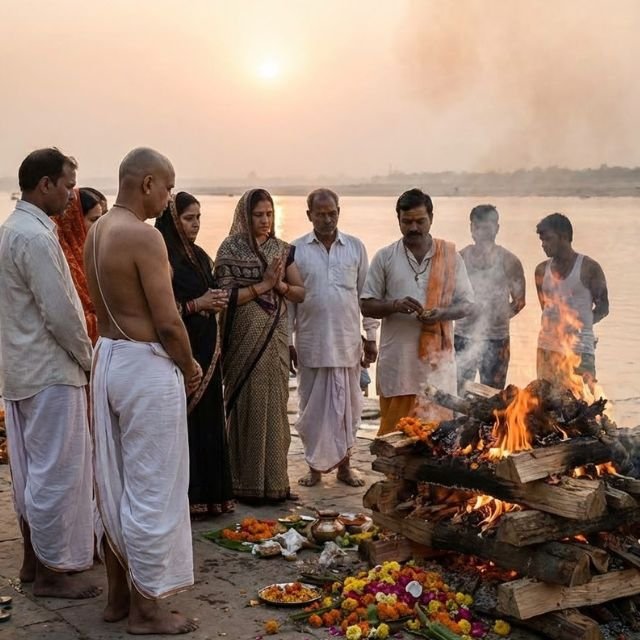
Once we reach the cremation grounds—whether it is Nigambodh Ghat in Delhi, Hindon Ghat in Ghaziabad, or the Madanpuri grounds in Gurugram—the main phase of the Antim Sanskaar (Antyesti Karma) begins.
Step 1: Cleaning and Decorating If not done at home, the body is bathed (symbolically or fully) with water and rubbed with Ghee and Sandalwood paste. This is the final grooming of the physical vessel.
Step 2: The Pyre (Chita) Wood, usually sandalwood or mango wood, is stacked. We ensure that the wood is dry and sufficient for a complete cremation. In modern times, many families opt for electric or CNG cremation. In such cases, the Vedic mantras of the Antim Sanskaar (Antyesti Karma) are performed before the body is placed into the furnace.
Step 3: Mukhagni (The Fire Offering) The eldest son (or designated karta) circles the pyre. He carries an earthen pot of water on his left shoulder. A hole is made in the pot during each round, letting water drain out, symbolizing that life is leaking away and time is running out.
Finally, he smashes the pot (breaking attachment) and lights the pyre at the mouth of the deceased. This moment, known as Mukhagni, is the climax of the Antim Sanskaar (Antyesti Karma).
Step 4: Kapal Kriya About halfway through the burning, a ritual called Kapal Kriya is performed. A bamboo pole is used to gently crack the skull. Spiritually, this releases the soul from the Crown Chakra (Sahasrara), allowing it to ascend to higher planes rather than being trapped in the skull.
Services We Offer in Delhi, Ghaziabad, and Gurugram
Navigating the bureaucracy of death can be difficult. We offer end-to-end management of Antim Sanskaar (Antyesti Karma) so you can focus on your family.
1. Priest Services We provide experienced Maha-Brahmins who specialize in Antyesti Vidhi. They are distinct from regular temple priests and know the specific mantras for the dead.
2. Hearse and Ambulance We arrange for freezer boxes (if cremation is delayed) and hearse vans decorated with flowers to transport your loved one from the hospital or home to the cremation ground.
3. Cremation Ground Booking In busy areas like Delhi, waiting times at Ghats can be long. We assist in coordinating the slot booking at major grounds like Lodhi Road, Punjabi Bagh, or Dwarka.
4. Material Arrangement We bring the complete Antyesti Samagri Kit, which includes:
Bamboo and ropes for Arthi.
White/Red cloth (Kafan).
Ghee, Sandalwood dust, and Incense.
Sesame seeds and barley.
Earthen pots and lamps.
Asthi Sanchay: Collection of Ashes
The Antim Sanskaar (Antyesti Karma) do not end when the fire goes out. The collection of bones (Asthi) is the next vital step.
Usually done on the 2nd or 3rd day (depending on local custom and the type of cremation), the ashes and bone fragments are collected in an urn (Kalash).
We guide you on how to handle the Asthi with respect. Until immersion, the urn must not be placed on the ground; it is usually hung on a tree or kept in a safe locker at the Ghat. We facilitate this entire process.
Asthi Visarjan: The Final Release
Following theAntim Sanskaar (Antyesti Karma), the ashes must be immersed in a holy river. This returns the element of Earth back to Water.
While Haridwar (Ganga) is the most popular destination, many families in NCR prefer Garhmukteshwar or the Yamuna Ghats for immediate immersion. We can arrange for:
Transportation to Haridwar/Garhmukteshwar.
Priest services at the immersion site.
Vidhi for the peace of the soul.
The 13-Day Mourning Period
The Antim Sanskaar (Antyesti Karma) are the beginning of a 13-day mourning cycle.
Day 1-10: Daily Pind Daan to help form the soul’s subtle body.
Day 11-12: Sapindikarana (Merging with ancestors).
Day 13: Terahvin (Feast and final purification).
For a detailed understanding of the post-cremation rituals, you can refer to our dedicated page on the Garuda Purana Path, which explains the soul’s journey in detail.
Why is Vedic Methodology Crucial?
In today’s fast-paced world, many funeral services have become transactional. However, the Antim Sanskaar (Antyesti Karma) are not a transaction; they are a duty.
If the mantras are not pronounced correctly, or if the Kapal Kriya is skipped, it is believed that the soul struggles to sever its earthly ties. This can lead to Pitru Dosh for future generations.
Our Pandits are trained in the specific scriptures of the Garuda Purana and Antyesti Paddhati. We ensure that whether you choose a wood pyre or an electric furnace, the Vedic sanctity remains compromised.
Challenges in Delhi NCR and How We Solve Them
Challenge 1: “Panchak” (The Five Constellations) If a death occurs during Panchak (a specific astrological period), it is considered risky for the family.
Solution: Our astrologers check the time of death immediately. If Panchak is present, we perform the necessary Panchak Shanti ritual using five effigies made of Kusha grass during the Antim Sanskaar (Antyesti Karma).
Challenge 2: Unavailability of Wood
Solution: We have tie-ups with vendors to ensure high-quality wood and cow-dung logs (Gau-Kasht) are available, which are eco-friendly and religiously compliant.
Challenge 3: Distance
Solution: We have a network of priests across Ghaziabad (Vaishali, Indirapuram), Gurugram (DLF, Sohna Road), and Delhi. We dispatch the nearest qualified team to reach you within an hour.
Preparing for the Inevitable
It is a hard topic to discuss, but planning the Funeral Rites (Antyesti Karma) in advance (Pre-Need Planning) is becoming common in metro cities. It spares the family from making financial and logistical decisions while they are in shock.
We offer consultation for elderly individuals who wish to document their final wishes—whether they want a specific type of wood, a specific Ghat, or specific donations (Godaan) to be made.
The Role of Technology
We blend tradition with technology.
Live Streaming: For relatives abroad who cannot fly down to Delhi in time, we provide a dignified live stream of the Antim Sanskaar (Antyesti Karma) via Zoom or private links.
Digital Obituaries: We assist in drafting and publishing obituaries in newspapers and digital platforms.
Cultural Variations
India is diverse, and so are its rituals. We respect all community traditions.
Punjabi/Sikh: We accommodate the specific path and customs.
Baniya/Jain: Strict adherence to non-violence and specific mantra chanting.
South Indian: We have Iyers and Iyengars in our network who follow the distinct South Indian funeral paddle.
Regardless of the community, the core essence of theAntim Sanskaar (Antyesti Karma) remains the liberation of the soul.
Frequently Asked Questions (FAQs)
Q1: What should we do if the death happens at night? According to Vedic texts, cremation is usually avoided after sunset. In such cases, the Funeral Rites (Antyesti Karma) are scheduled for the next morning. We provide freezer boxes to preserve the body at your home overnight.
Q2: Is it mandatory for the eldest son to light the pyre? Traditionally, yes. However, if there is no son, the wife, daughter, or younger brother can perform the rites. The Vedas are flexible when the intent is pure. We guide the family on the correct protocol.
Q3: How much does the complete service cost in Delhi? The cost varies based on the cremation ground fees, the hearse van type, and the materials used. We provide a transparent breakdown with no hidden costs during your time of grief.
Q4: Can we perform Antyesti Karma for someone who died elsewhere? If the body is lost or the death happened far away, a ritual called Kusha Putla Dah (burning an effigy made of grass) can be performed. This serves as a symbolic Antim Sanskaar (Antyesti Karma).
Q5: Why do we shave the head after the rites? The chief mourner shaves his head (Mundan) to signify the shedding of ego and a return to a state of purity and simplicity, marking the start of the mourning period.
Understanding the Emotional Weight
We know that when you call us for Antim Sanskaar (Antyesti Karma), you are going through the worst day of your life. Our team is trained to be invisible yet supportive. We handle the noise, the paperwork, and the crowd, allowing you to have your final moments of silence with your loved one.
The smoke of the pyre rising to the sky is not just combustion; it is the soul riding the vehicle of Agni to merge with the cosmos. It is the ultimate freedom.
For a deeper academic understanding of these rites, you can read about Antyesti on Wikipedia.